
Almost every thermal break profile fails at the same place: the crimp. Knurling and strip insertion get the attention, but it is the rolling stage that closes the aluminum over the polyamide strip, and a crimp that is 0.1 mm uneven will show up as a measurable loss of shear strength long after the machine has been accepted.
That is why the choice between a conventional and a CNC thermal break rolling machine matters more than its price difference suggests. The two machines perform the same physical operation; they differ in how much of the setup depends on the operator.
1. The operation both machines perform
After the PA66 strip has been inserted, the profile passes between roller sets that press the aluminum walls inward and over the strip. The strip is trapped mechanically — no adhesive, no screws. Crimp depth, roller pressure and roller alignment along the profile decide whether the joint survives thermal cycling between −20 °C and +80 °C without the strip migrating.
Three things have to be right at the same time: the top and bottom rollers must close to the same depth, the left and right heads must stay aligned over the full profile length, and the pressure must be high enough to deform the aluminum without crushing the strip.
2. How a conventional rolling machine works
A conventional machine sets those three variables with handwheels, mechanical stops and shims. An experienced operator dials in a new profile by trial: run a short piece, measure the crimp, adjust, run again. On a simple rectangular section this takes 20–40 minutes and produces a few metres of scrap.
There is nothing wrong with the method — it produced most of the thermal break profiles in use today. Its weakness is repeatability. Once the setup is broken, the numbers on the handwheels are all you have, and handwheel counts are not the same as millimetres. Two operators setting the same profile will not produce the same crimp.
3. How a CNC thermal break rolling machine works
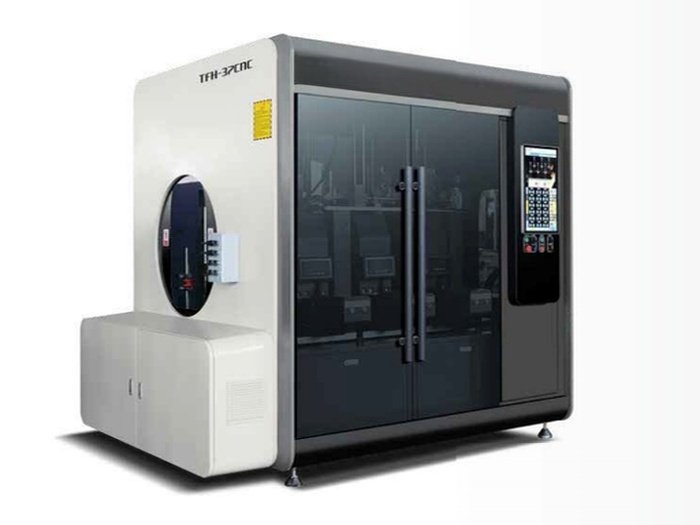
A CNC machine replaces the handwheels with servo axes. Each axis holds position at ±0.05 mm and returns to it on command, so a profile is defined once — as a program — and recalled afterwards. Every machine in the current range stores 2,000+ profiles with one-button recall, which in practice means the setup step disappears for anything you have run before.
The second difference is that axes can move independently during the pass. That is what makes correction of profile misalignment possible, and it is the subject of section 6.
4. Side-by-side comparison
| Dimension | Conventional machine | CNC thermal break rolling machine |
|---|---|---|
| Setup for a new profile | 20–40 min by trial and measurement | Program recall, minutes; first article checked, not adjusted |
| Repeatability between operators | Depends on skill and notes | Same position every time, ±0.05 mm |
| Changeover frequency that stays economic | One or two families per week | Several families per shift |
| Misaligned or asymmetric sections | Compensated with shims and re-clamping | Corrected by axis offset, in one pass |
| Scrap during setup | Metres per changeover | First piece only |
| Operator requirement | Experienced setter | Operator who can load a program and judge a sample |
| Maintenance profile | Mechanical, simple, cheap parts | Servo and controller service, diagnostics via screen |
| Purchase price | Lowest | Higher, scaled by axis count |
5. Where a conventional machine still wins
Three cases are genuinely better served by a conventional machine:
- Single-profile production. If the machine is set once for a season, there is nothing to recall and nothing to repeat.
- Very low volume, price-sensitive projects. When the machine runs a few hours a week, the CNC premium never returns.
- Simple rectangular sections with generous tolerances. Where a handwheel setup is accurate enough, extra axes add cost without adding quality.
The honest test is not “how advanced is the machine” but “how many times per month will someone have to set it up”. Below roughly two changeovers a month, conventional is fine. Above two a week, the arithmetic usually flips.
6. Where CNC pays back: misalignment and complex sections
Thermal break profiles are rarely perfectly symmetric after extrusion, and the strip channel is rarely perfectly centered. Two failure patterns are common on a conventional machine: the rollers crimp one side deeper than the other, or the rear head loses contact because the profile twists slightly along its length.
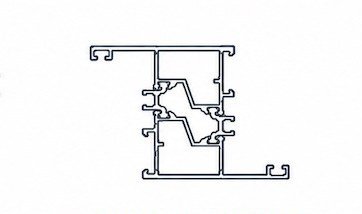
On a CNC machine these are axis offsets, not mechanical problems. Translating the front heads corrects left/right deviation; lifting the rear head corrects up/down deviation; doing both at once handles the compound case. Each model in the range adds axes for exactly this reason:
| Model | Total power | Weight | What the extra axes buy |
|---|---|---|---|
| 11-axis | 11.5 kW | ≈ 1,610 kg | Standard single and double groove profiles; 2,000+ program memory covers a normal window catalogue. |
| 14-axis | 11.5 kW | ≈ 1,610 kg | Adds 3-axis CNC lifting for profiles with high/low grooves — both sides crimped at the same depth without shimming. |
| 17-axis | 13.5 kW | ≈ 1,838 kg | Front heads translate and the rear head lifts: compound misalignment in one pass. |
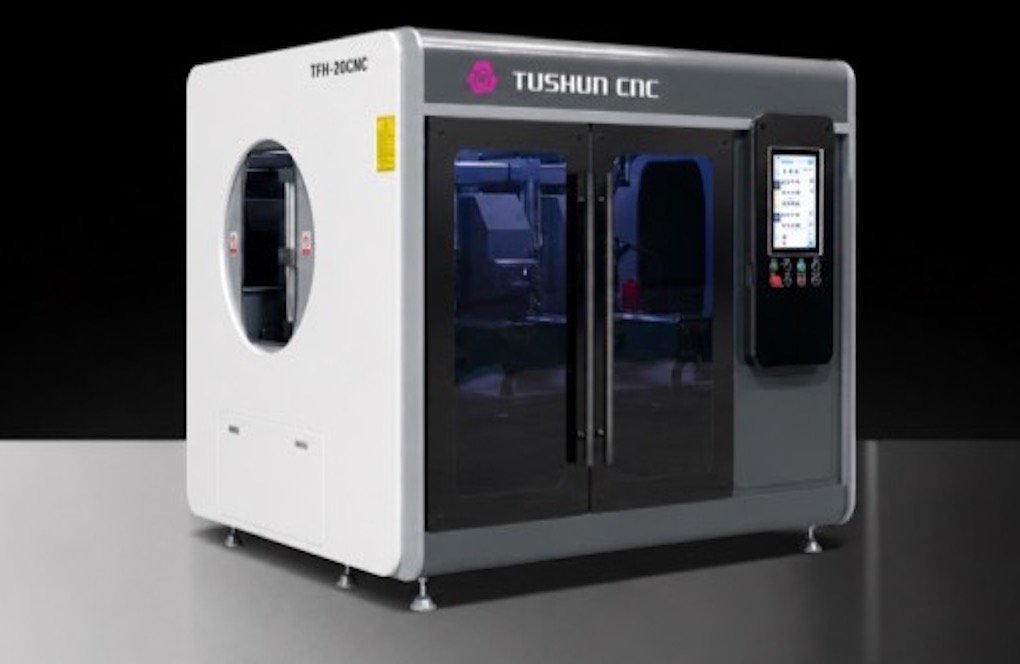
| 20-axis | 16.6 kW | ≈ 2,000 kg | QR scan-to-produce import and automatic nesting for mixed, fast-changing production. |
| 37-axis | 23.4 kW | — | Every pressure roller on its own servo: irregular and non-standard sections with no dead angle. |
7. A simple payback calculation
Payback arguments go wrong when they compare purchase prices and ignore setup hours. A more useful framing, with your own numbers substituted:
- Count changeovers per month and multiply by the hours each one takes today, including trial runs.
- Multiply by the loaded hourly cost of the people involved — usually a setter plus an operator.
- Add the scrap produced per setup, priced at your profile cost per metre.
- Add rework caused by crimp variation that the operator cannot see: returns, failed shear tests, re-crimping.
Factories that run 40–60 changeovers a month typically find the annual figure lands in the same order of magnitude as the price gap between a conventional machine and an 11- or 14-axis CNC machine. Below 10 changeovers a month, it usually does not.
8. Decision checklist
- Profile families per month: 1–2 → conventional; 3–10 → 11 or 14 axes; 10+ with mixed sections → 17 or 20 axes.
- Any profile with high/low grooves or visible misalignment → start at 14 axes, not 11.
- Irregular or non-standard sections that no catalogued roller set fits → 37-axis platform.
- Existing ERP or production scheduling system → ask for the QR import option; it removes the manual program lookup step.
- Operators with no CNC experience → the constraint is training, not the machine; plan the first two weeks accordingly.
Frequently asked questions
Can a conventional machine be retrofitted to CNC?
Mechanically it is possible to add servo drives to an existing frame, but the cost approaches a new machine once controllers, feedback and safety are included, and the roller geometry stays limited by the original design. In practice, factories keep the conventional machine for one dedicated profile and buy a CNC machine for everything else.
How much scrap does a CNC machine still produce?
The first piece after a program recall, and any piece after a tooling change. That is usually one profile length per changeover rather than the several metres a trial-and-error setup consumes.
Does a CNC machine need a different power supply?
All models run on 380 V / 50 Hz, with total power rising from 11.5 kW on the 11- and 14-axis machines to 23.4 kW on the 37-axis machine. The difference matters when sizing the workshop distribution board, not the machine itself.
See the models
All five configurations, from 11 to 37 axes, are compared on the thermal break rolling machine page. If you are still deciding between machines and a full line, this comparison of assembly machines and assembly lines covers the investment logic; the crimping stage itself is described on each model page.
Building or upgrading a thermal break line?
Send your profile drawings — we reply with a machine configuration, cycle time and price range within 12 working hours.