
Labor is the second-largest cost in a thermal break aluminum profile operation after aluminum itself, and it is the one most factories measure worst. Wages are visible; the hours lost to carrying profiles between machines, re-running a mis-crimped batch, or resetting a machine for the next profile family are not.
This article breaks a thermal break production line into the stages where labor is actually consumed, then separates the cost that automation removes from the cost it merely moves.
1. Where the labor actually goes
A typical line has six points where a person is required, and only two of them are machine operators:
- Sawing and loading. Cutting to length and feeding the first machine. One person can usually cover two machines if they are adjacent.
- Knurling and strip insertion. One operator per machine on a non-integrated layout, because knurling and insertion happen at separate stations.
- Transfer between stages. The hidden cost: lifting 6 m profiles off one outfeed table and onto the next infeed. Two people are often needed for long profiles to avoid twisting them.
- Rolling and crimping. One operator, plus a setter on call for changeovers.
- Inspection. Crimp depth and strip position sampling, usually by the operators themselves on small lines.
- Stacking, packing and labelling. One person at the end of the line, and it is rarely the bottleneck until output rises.
On a manual layout the transfer step alone can absorb the equivalent of one full-time person per shift for a line running long profiles at moderate output. It is also where most surface damage happens, which turns a labor cost into a quality cost.
2. The four labor costs automation actually removes
- Handling between stages. Conveyors and transfer tables replace lifting. This is the largest single saving on a line, and the one most often left out of payback calculations.
- Rework. A mis-crimped profile is either scrapped or re-crimped by hand, both of which consume hours that appear in nobody’s plan. Controlled crimp depth reduces the volume of rework rather than making it faster.
- Changeover. Program recall replaces trial-and-error setting. On a line running three or four families a week, this is worth more than the handling saving.
- Inspection dependence. When the machine holds ±0.05 mm, inspection becomes sampling rather than supervision — one person can watch more stations.
3. Machine-level or line-level automation?
There are two ways to buy the same saving, and they are not interchangeable.
Machine-level automation means buying CNC knurling and CNC rolling machines but keeping a manual layout. You remove setup time and rework, and you keep the transfer labor. This is the right first step when output is under roughly 100 pieces per hour or when the profile catalogue is still changing.
Line-level automation connects the machines with conveyors and a common control scheme. You remove transfer labor as well, and you gain the ability to run one operator across several stations. It only makes sense once the process itself is stable — a line running unstable crimps just produces scrap faster.
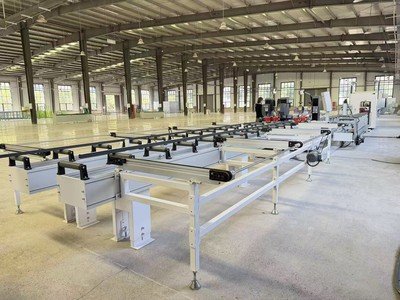
| Configuration | Capacity | Published labor cost reduction | Production efficiency |
|---|---|---|---|
| T700 full-automatic line | 120–240 pcs/h | Up to 40% | Up to 40% higher |
| T700Max modular line | 120–240 pcs/h | Up to 70% | Up to 50% higher |
| T700Pro intelligent line | 120–240 pcs/h | Up to 50% | Up to 50% higher |
The differences between the three configurations are not only about speed — all three cover 120–240 pieces per hour. They differ in how much of the changeover, transfer and monitoring work is taken over by the line rather than left to the crew.
4. What the saving looks like on a shift basis
The following example uses round numbers and is meant to be replaced with your own, not quoted:
- Two shifts, 22 working days, 4 people per shift on a manual layout = 176 person-shifts per month.
- A connected line with the same output needs 3 people per shift = 132 person-shifts, before accounting for changeover.
- Add the changeover saving: 30 changeovers per month, 40 minutes each, two people = 40 person-hours, roughly 5 person-shifts.
- Add rework: if 2% of output is re-crimped or scrapped and half of that disappears, the recovered hours are usually worth more than the headcount saved.
Note what the calculation does not include: floor space, which a compact line frees up; or the reduction in damage during transfer, which shows up in the quality report rather than in the wage bill.
5. What automation does not fix
Three costs stay, and pretending otherwise is how automation projects get a bad reputation:
- Maintenance skill. A line needs someone who can read a fault code and change a servo drive. That person costs more than the operator they replace.
- Programming and tooling. Every new profile family still needs a program and usually a cutter set. The work moves from the shop floor to an engineering desk; it does not vanish.
- Quality decisions. Sampling still happens, and someone still has to decide whether a batch passes a shear test.
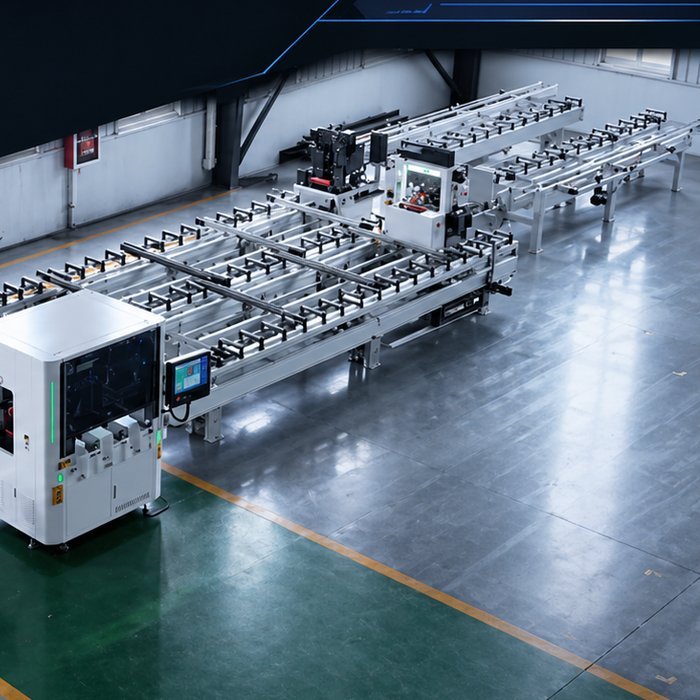
On-site testing of a thermal break assembly line before shipment — the stage where transfer times and operator positions are confirmed against real profiles.
6. A staged path that keeps the saving visible
Most factories that get this right do it in three steps rather than one purchase order:
- Replace the setup-bound stages first. A CNC knurling and strip insertion machine and a CNC rolling machine. Setup and rework drop immediately, and the numbers are easy to verify before the next step.
- Connect the two. A conveyor between knurling and rolling removes the transfer step and one person per shift.
- Add the ends. Automatic saw infeed and stacking outfeed, which is where the remaining manual handling sits.
The advantage of staging is that each step can be measured against the cost it was supposed to remove. A single large order makes it much harder to tell which part of the line is actually earning its keep.
7. Three mistakes that erase the saving
- Buying the line before stabilising the profile catalogue. A line is efficient at repetition. If the catalogue changes every month, the line spends its time being re-tooled.
- Under-sizing compressed air. Every station uses air at 0.6–0.8 MPa. A compressor sized for the old layout becomes the reason the line runs at 70% of its rated capacity.
- No space for infeed and outfeed. The machines fit; the 6 m profiles do not. This is the most common layout error and the most expensive to correct after installation.
Frequently asked questions
How many operators does a thermal break production line need?
A connected automatic line typically runs with two to three people per shift: one at the control station, one at outfeed and packing, and one shared for changeovers and inspection. A manual layout running the same output usually needs four to six, mostly because of transfer between machines.
Is labor cost reduction the main reason to automate?
In high-wage markets, yes. In markets where labor is cheap but skilled setters are scarce, the stronger argument is usually consistency: a line produces the same crimp on the first and last piece of a shift, which reduces rework, returns and re-testing.
Can a line run different profile families in one shift?
Yes, provided the programs exist and the tooling is on the machine. Changeover on a programmed line is measured in minutes for the settings and in tens of minutes when cutter sets have to be swapped.
Where to start
The thermal break assembly line page compares the three line configurations against capacity and staffing, and this article on production capacity explains which factors cap output before labor does. If you send your current headcount, output and changeover frequency, we can model the three stages against your numbers.
Building or upgrading a thermal break line?
Send your profile drawings — we reply with a machine configuration, cycle time and price range within 12 working hours.