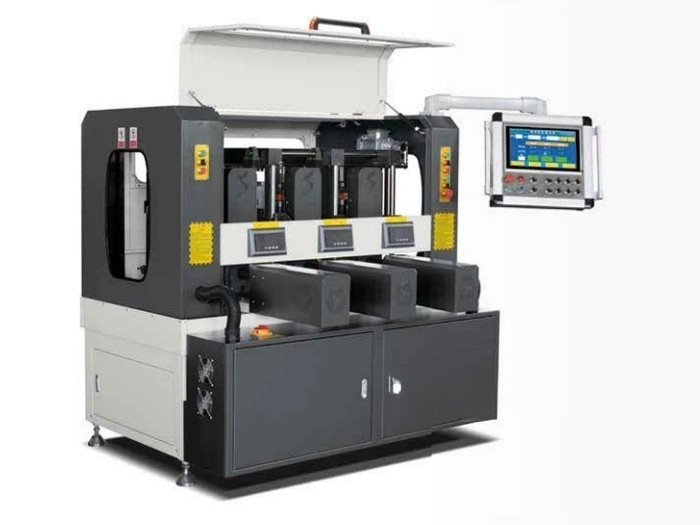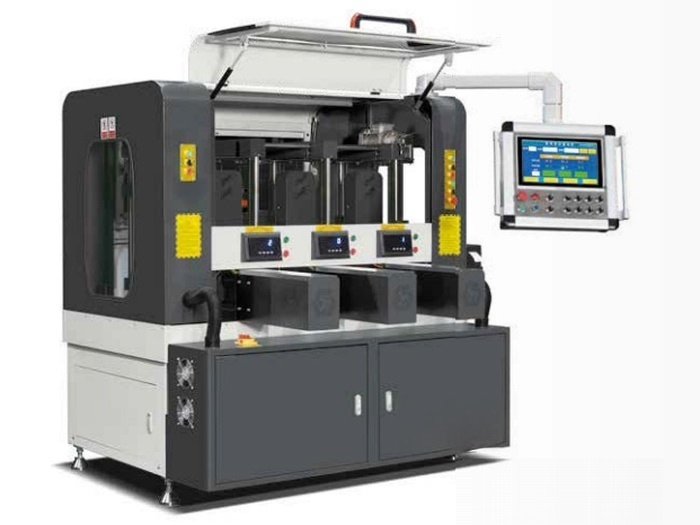
Overview
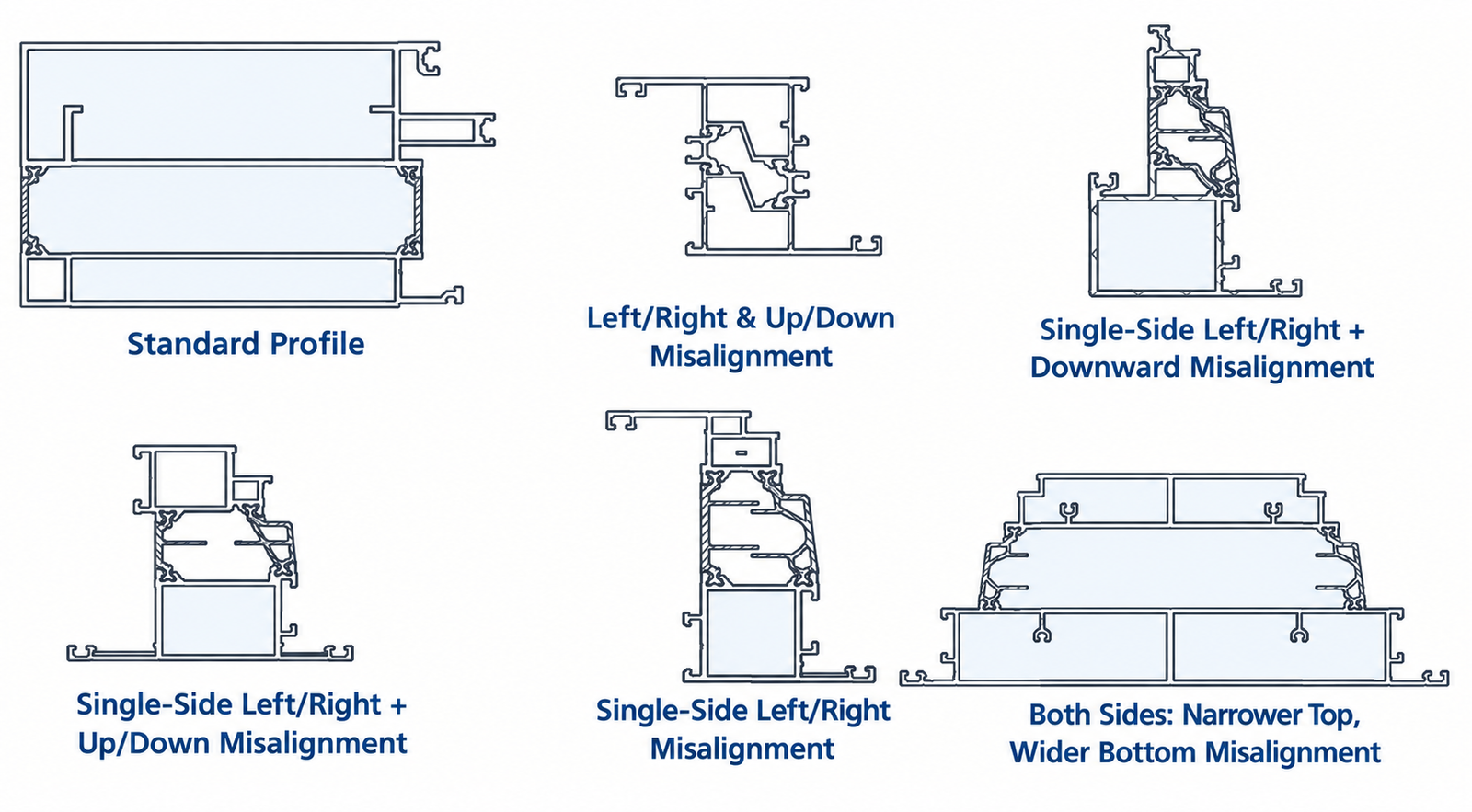
The TFH-17CNC handles compound misalignment in both directions: the front separation upper cutter heads (3 segments) translate forward and backward while the rear separation lower cutter head lifts up and down. Profiles whose strip and groove are offset on both axes — typical of shaped window and curtain-wall sections — come out crimped in a single pass.
Six cutter-head groups are numerically adjusted for 80–100 mm strips, 17 axes support quick changeover, and more than 2,000 profile programs are stored for one-button recall. The machine can be ordered as an ERP model for data interconnection with factory systems.
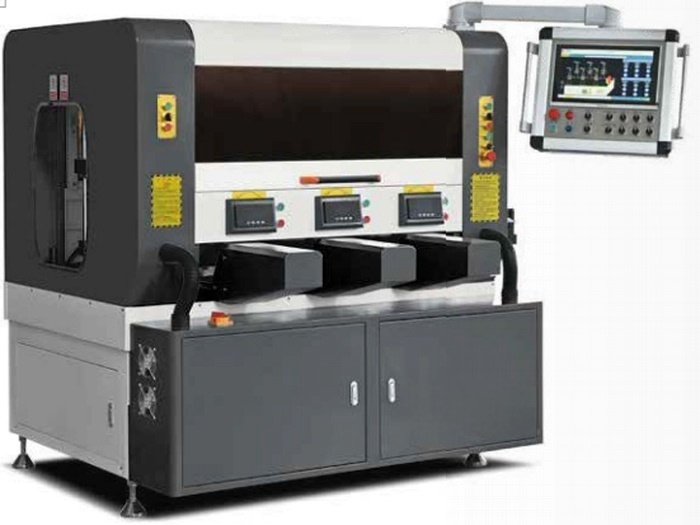
Key Features
- Two-direction misalignment — front separation upper cutter heads translate forward/backward; rear separation lower cutter head lifts up/down.
- Six CNC cutter-head groups for 80–100 mm strips, with CNC lifting nylon cots and three CNC pressure groups.
- Fast changeover — 17-axis CNC and 2,000+ stored aluminium profile programs with one-button positioning.
- Free strip-width adaptation — cutter-head width adjusts without tooling changes.
- Profile straightening — nylon cots raise and lower to correct bending quickly.
- ERP machine option — configurable for ERP integration on request.
Technical Specifications
| Parameter | Value |
|---|---|
| Power supply | 380 V / 50 Hz |
| Total power | 13.5 kW |
| CNC axes | 17-axis CNC |
| Cutter-head separation distance | 0–180 mm |
| Cutter-head opening height | 8–90 mm |
| Max. profile cross-section | 300 × 300 mm |
| Positioning accuracy | ± 0.05 mm |
| Profile feeding speed | 6–60 m/min |
| Overall dimension | 1700 × 1550 × 1850 mm |
| Machine weight | ≈ 1,838 kg |
| Profile program memory | 2,000+ profiles, one-button recall |
| ERP machine option | Available on request |
Profile Misalignment States
The 17-axis configuration adds profile misalignment and synchronized profile + strip misalignment to the up/down states.
Working Process
- Feeding — the knurled and strip-inserted profile enters the rolling station on the infeed conveyor.
- Positioning — the program recalls 17 axes: the front separation upper cutter heads translate forward and backward while the rear separation lower head lifts up and down, so an offset on both axes is corrected before the first roller touches the profile.
- Rolling & crimping — the heads press the groove walls over the strip to the stored crimp value with both corrections held in position, which is what keeps a compound-misaligned section from rolling out of square.
- Output — finished profiles leave straight and parallel, ready for packing, machining or the thermal break assembly line.
Quality & Standards
Every TFH machine is assembled and inspected above industry standard with a three-step pre-delivery inspection. On the 17-axis model the check uses a compound-misalignment test piece — offset both up/down and front/back — crimped in one pass and sectioned so both groove walls can be measured. Rolled sections hold longitudinal shear to GB/T 5237.6-2017 and bending to the high-precision class of GB/T 5237.1-2017.
Applications
- Shaped window and curtain-wall sections whose strip and groove are offset on both axes.
- Plants running several profile families per shift, where changeover time rather than rolling speed sets the day’s output.
- Factories wiring machines into ERP or MES — the 17-axis model can be ordered as an ERP machine for data interconnection.
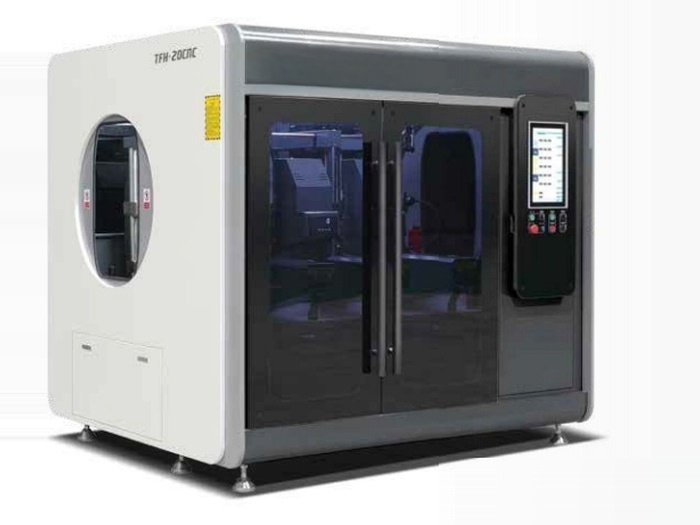
Part of the TFH rolling & crimping range — five models from 11 to 37 axes. For special-shaped sections and QR-coded drawing import, the TFH-20CNC takes the same correction further.
FAQ
What does compound misalignment mean?
Offset in two directions at once: the strip groove sits higher on one side and also steps forward or backward along the profile. Correcting one direction with a fixed head pushes the other out of line, which is why this machine moves the front upper heads and the rear lower head independently.
17 or 20 axes — which one do I need?
The 17-axis machine corrects compound misalignment from stored programs. The 20-axis adds scan-code one-key import with automatic nesting and independent servo adjustment of every pressure parameter — worth it when changeovers are frequent or your drawings are already QR-coded.
Can it connect to our ERP?
Yes. The TFH-17CNC can be ordered as an ERP machine with digital-twin and data interconnection for factories running digital production management.