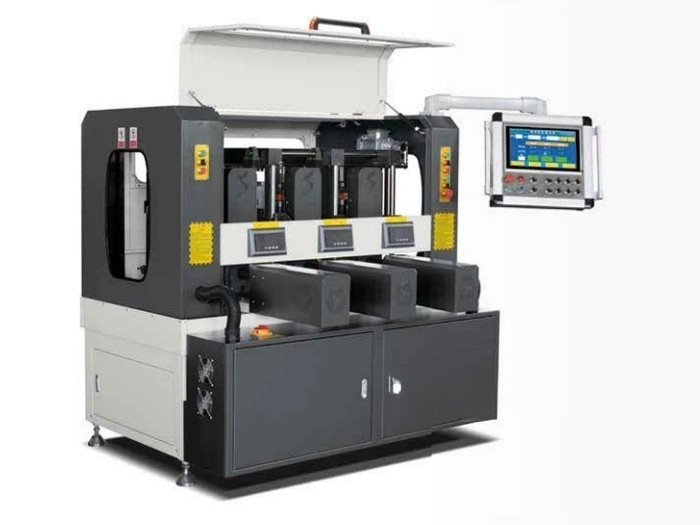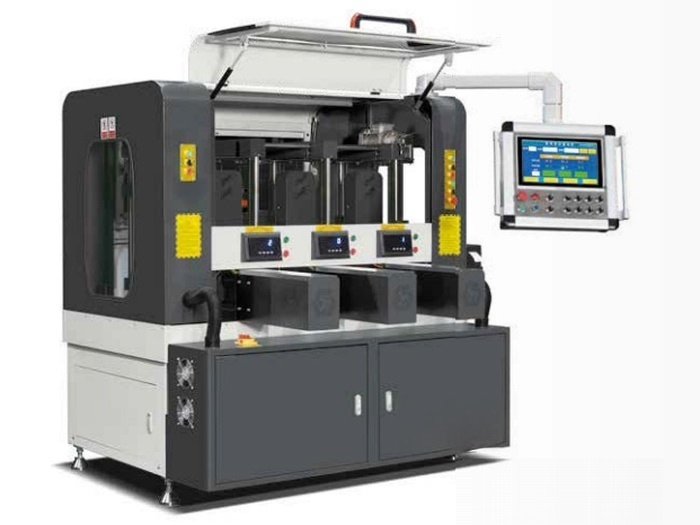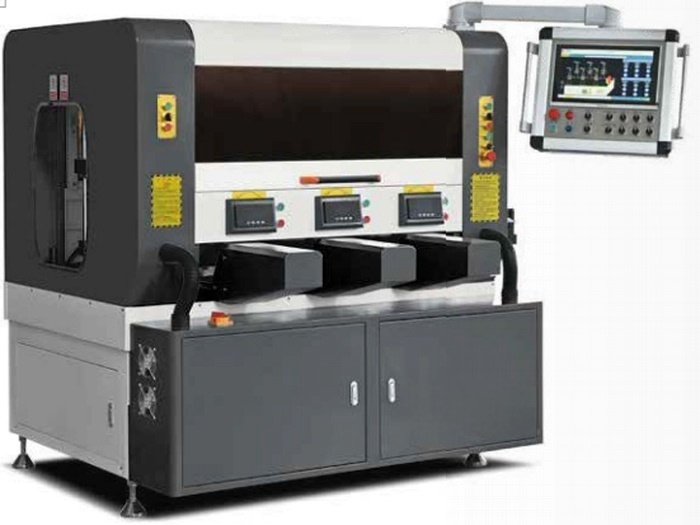
Overview
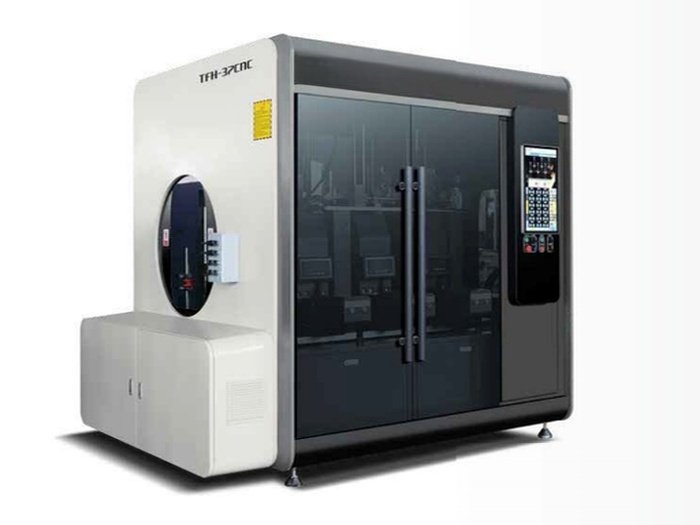
The TFH-37CNC is the flagship of the family: 37 independent servo motors drive every axis, giving full-dimension pressure control that no conventional rolling machine can match. Scan the profile QR code and every roller positions itself at once — yet each rolling step can still be trimmed individually when a job demands it.
It was built for the profiles other machines refuse: rear cutter-head groups adjust up/down and front/back, front cutter-head shafts move forward and back independently, and every pressure roller offers free adjustment of spacing, angle and position with no dead angles. Irregular and non-standard thermal-break profiles are crimped in one pass with zero dimensional deviation. An ERP machine option is available for digital-twin and data interconnection.
Key Features
- 37 independent servo axes — every roller axis driven and positioned by its own servo for full-dimension precise pressure control.
- One-scan positioning — QR code loads all rolling parameters at once; each process step remains individually adjustable.
- Unconventional misalignment solved — rear cutter group adjusts up/down plus front/back; front cutter shafts move forward/back independently.
- No dead-angle adjustment — spacing, angle and position of every pressure roller adapt freely to the profile.
- Standards compliance — profiles do not de-strip after rolling; longitudinal shear meets GB/T 5237.6-2017 and bending meets the high-precision class of GB/T 5237.1-2017.
- ERP machine option — available for factories running digital production management.
Technical Specifications
| Parameter | Value |
|---|---|
| Power supply | 380 V / 50 Hz |
| Total power | 23.4 kW |
| CNC axes | 37-axis servo joint control |
| Cutter-head separation distance | 0–180 mm |
| Cutter-head opening height | 8–90 mm |
| Max. profile cross-section | 300 × 300 mm |
| Positioning accuracy | ± 0.05 mm |
| Profile feeding speed | 6–60 m/min |
| Overall dimension | 2050 × 1960 × 2250 mm |
| Machine weight | ≈ 2,500 kg |
| Profile program memory | 2,000+ profiles, one-button recall |
| ERP machine option | Available on request |
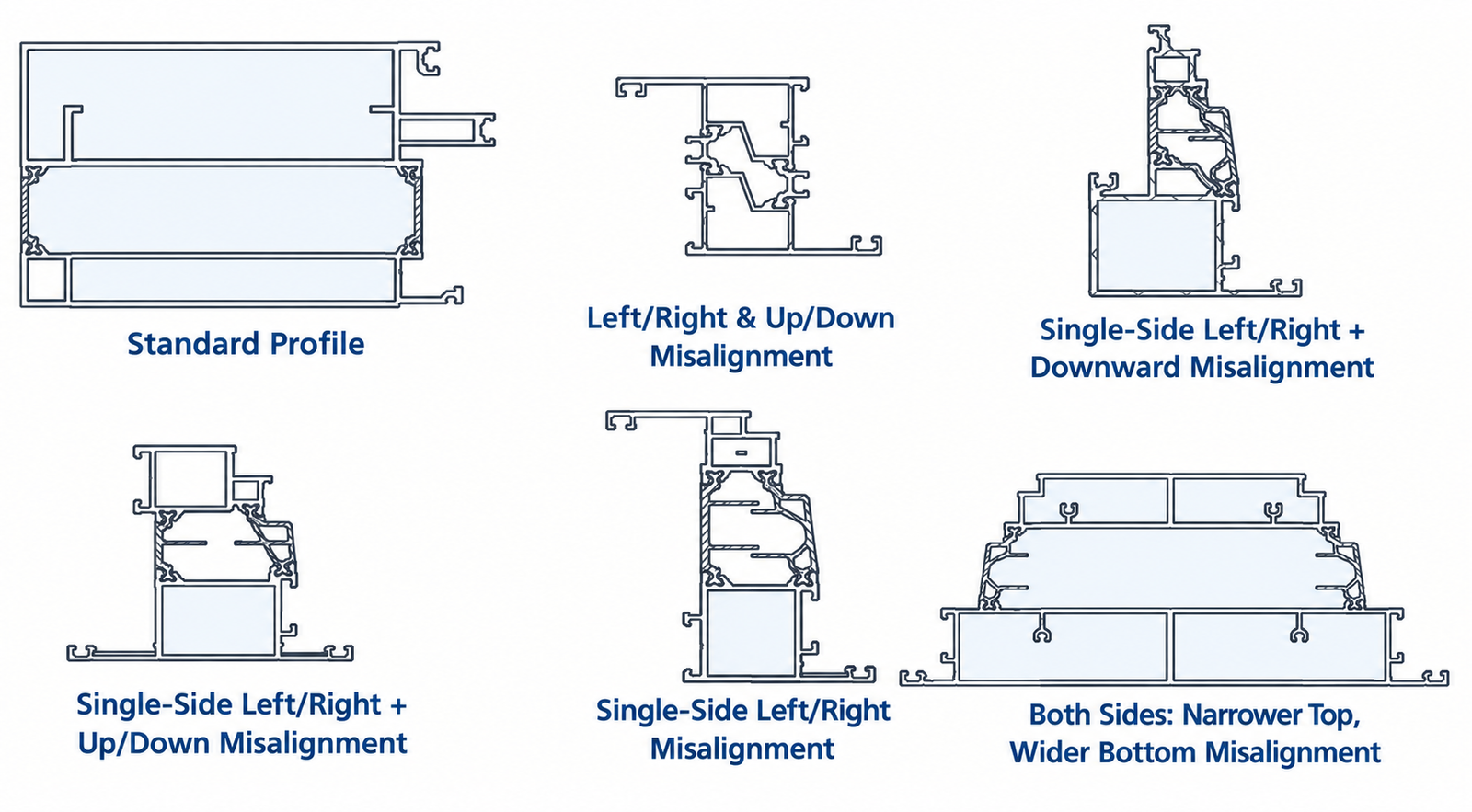
Profile Misalignment States
The 37-axis machine was designed for unconventional, irregular and non-standard misaligned profile families.
Working Process
- Feeding — the knurled and strip-inserted profile enters the rolling station on the infeed conveyor.
- Positioning — the QR scan sets all 37 axes at once, but each axis is driven by its own servo, so spacing, angle and position of every pressure roller stay individually adjustable — there are no dead angles to work around.
- Rolling & crimping — each rolling step can be trimmed on its own while the rest of the program stays as imported; irregular and non-standard sections are crimped in one pass without dimensional deviation.
- Output — finished profiles leave straight and parallel, ready for packing, machining or the thermal break assembly line.
Quality & Standards
Every TFH machine is assembled and inspected above industry standard with a three-step pre-delivery inspection. On the 37-axis model every axis is verified against the drawing before shipment, then a non-standard section — the kind with asymmetrical or stepped grooves — is crimped and sectioned to confirm it does not de-strip. Rolled sections hold longitudinal shear to GB/T 5237.6-2017 and bending to the high-precision class of GB/T 5237.1-2017.
Applications
- Non-standard and irregular thermal-break sections other machines cannot reach inside the 0–180 mm cutter-head span.
- Curtain-wall, industrial and transport profiles with asymmetrical or stepped strip grooves.
- Plants building a digital twin — the ERP machine option exposes axis data for interconnection.
Part of the TFH rolling & crimping range — if your sections stay inside standard groove geometry, the TFH-20CNC covers them at lower cost.
FAQ
Which axis configuration do I need?
Standard single-groove profiles run on the 11-axis machine; high/low grooves need the 14; compound misalignment the 17 or 20; sections whose groove geometry falls outside what the heads can reach need the 37. Send the cross-sections and we will confirm — or compare all five models on the TFH range page.
What justifies 37 axes over 20?
Geometry, not volume. The 20-axis machine covers special-shaped sections inside its head span; the 37-axis machine exists because every roller can be positioned independently in spacing, angle and position — which is what asymmetrical and stepped grooves need.
Can it connect to our ERP?
Yes — available as an ERP machine with digital-twin and data interconnection.