
A CNC knurling machine decides two things that are expensive to fix later: how well the PA66 strip locks into the aluminum, and how many profile families your team can change over to within one shift. Every other line on the specification sheet is a consequence of those two.
This guide is written for the person who signs the purchase order — usually a production manager or an owner adding thermal break capacity — and it follows the order in which the specifications actually constrain your choice, not the order in which catalogues list them.
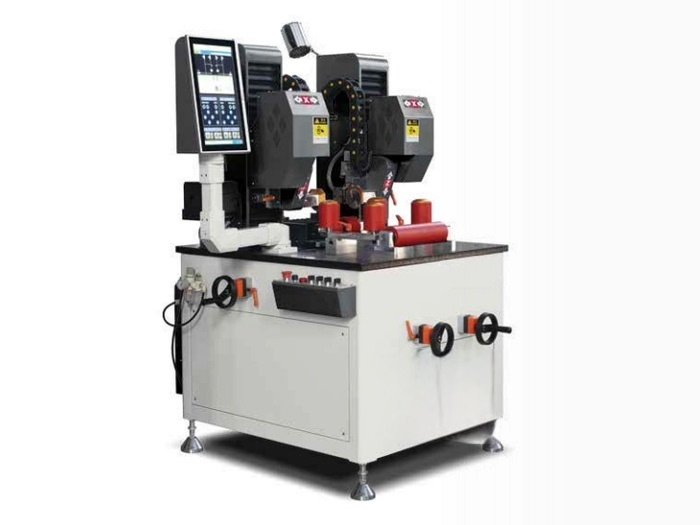
1. What a CNC knurling machine does in a thermal break line
Knurling is the first mechanical step after sawing. A set of rotating cutters presses a serrated pattern into the two inner walls of the strip channel, raising teeth of roughly 0.3–0.6 mm. The polyamide strip is then pushed into that channel under controlled pressure, and the teeth bite into the PA66 surface.
That bite is the whole point. Thermal break profiles hold together through mechanical engagement, not adhesive. If the knurl is too shallow, the strip can migrate under thermal cycling and the profile loses shear strength. If it is too deep or too sharp, the strip is scored and cracks at the root of the tooth. The window between the two is narrow, which is why knurl depth and strip insertion pressure have to be repeatable — not “set once by feel”.
After insertion, the assembly moves to a thermal break rolling machine, where rollers crimp the aluminum over the strip and close the channel. Knurling, insertion and crimping form the mechanical core of any thermal break assembly line; everything before and after is handling.
2. The five numbers that decide whether a machine fits
Catalogues list fifteen or twenty specifications. Five of them decide whether the machine can run your profiles at all; the rest describe how comfortably it does so.
| Specification | Typical value | What it actually decides |
|---|---|---|
| Knurling cutter adjustment range | 10–200 mm (W) × 0–240 mm (H), or 10–230 × 0–260 on ZX models | The largest profile cross-section the cutter heads can straddle. Profiles outside this envelope need a different machine, not a different setting. |
| Insulating strip adjustment range | 0–50 mm, 0–65 mm on the 7-axis model | The strip width range you can run. Standard 24 mm and 14.8 mm strips sit well inside 50 mm; wide door strips may not. |
| Positioning accuracy | ±0.05 mm | Whether the knurl depth stays constant along the profile and between batches. It is also the reason a CNC machine can hold a program and a manual one cannot. |
| Profile feeding speed | 6–60 m/min | Real throughput. 6 m/min is the slow end used for short, deep sections; 60 m/min is for long runs of simple profiles. |
| Total power | 3.6–10 kW | Transformer and cable sizing. Small machines run from a 380 V / 50 Hz supply without a dedicated transformer in most factories. |
Two numbers are easy to overlook. Air source pressure (0.6–0.8 MPa) determines whether the strip clamp and cutter compensation work reliably — a factory running at 0.5 MPa will see intermittent insertion faults that look like machine faults. Machine weight (580–1,130 kg across the range) determines floor loading and whether a standard pallet truck can move it.
Why the cutter range and the strip range have to be read as one pair
Knurling and strip insertion are one operation, not two. The cutters open the teeth on both inner walls of the channel, and the feeder pushes PA66 into the channel the cutters have just prepared. Specify the two independently — a machine that straddles your section but cannot feed your strip — and the failure does not look like a specification error. It looks like a feeding fault, and it appears after the machine is on your floor.
Three symptoms point back to a mismatch rather than to an operator having a bad day: the strip rides up one wall of the channel, the insertion pressure has to be raised a little more each run, or the strip sits at a slight angle that only becomes visible once the rollers crimp the channel closed. Because the strip enters immediately behind the cutter heads, a small error in either range compounds through the rest of the line.
The consequence for a buyer is procedural: put the strip width and thickness in the same document as the section drawing, and ask the supplier to confirm the cutter envelope and the strip range together, in writing. A machine that fits the profile but not the strip is still the wrong machine, and it is the one mistake that no amount of operator training corrects.
3. Axis count: what 5, 6, 7, 10 and 11 axes actually control
Every axis is one motorised adjustment that used to be a handwheel, a shim or a mechanical stop. Axis count is therefore not a performance score — it is the number of setup variables the machine can recall instead of you resetting by hand.
- 5 axes — cutter head vertical and horizontal position, head angle, strip guide position, insertion pressure. Covers standard single-side profiles with 24 mm strip. This is the TKC-5CNC, 3.6 kW, roughly 580 kg.
- 7 axes — adds a lower cutter head and a wider strip range (0–65 mm), so profiles with a deep lower groove can be knurled from both sides of the channel without re-clamping. That is the TKC-7CNC.
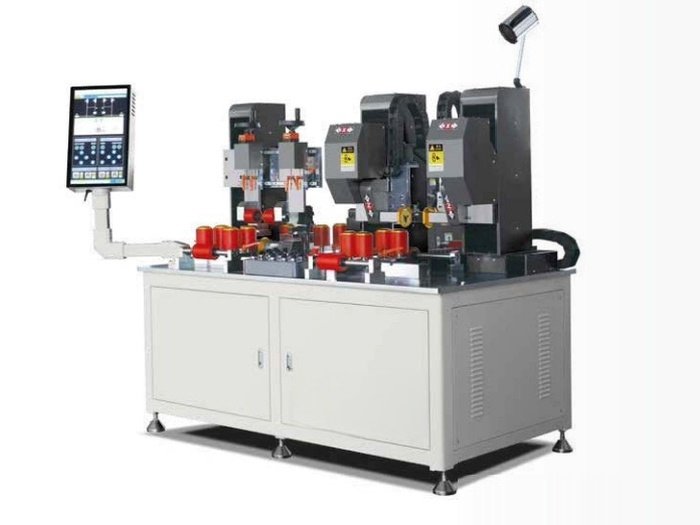
- 11 axes — the second head becomes a full double-side station: both walls of the channel are knurled in the same pass and the profile does not need to be flipped. See the TKC-11CNC.
- 6 and 10 axes (ZX series) — same logic applied to wider sections: 230 mm cutter width, 260 mm height, plus a dedicated channel for logo film application. The TKC-ZX-6CNC and TKC-ZX-10CNC.
4. Single-side or double-side knurling?
The practical difference appears the moment you run a profile whose two walls sit at different heights, or a section that is too heavy to flip comfortably. On a single-side machine, that profile is knurled in two operations with a manual turn in between; the second knurl rarely matches the first, and the mismatch shows up later as uneven crimping.
Double-side knurling removes the turning step, but it only pays for itself when a meaningful share of your catalogue has asymmetric or heavy sections. For a factory running window series profiles in the 60–120 mm range, single-side is usually sufficient, and the extra axes are money better spent on tooling.
5. Match the machine to the profile family, not to the price list
Three situations cover most purchases, and each points to a different configuration:
- Standard window and door series, 24 mm strip. Cutter envelope 200 × 240 mm is more than enough. A 5-axis machine at 3.6 kW will outrun the rest of the line for years.
- Mixed catalogue with deep grooves and cold-bent profiles. Lower cutter head and the 0–65 mm strip range matter more than axis count on paper. Look at the 7-axis configuration before looking at the 11-axis one.
- Curtain wall, wide sections, logo film. You need the 230 mm × 260 mm envelope and the extra film channel; that is the ZX platform, not a stretched standard machine.
6. What a manual machine still does well
If your factory runs one profile family for months at a time and your operator has run the same setup for years, a manual knurling machine is not a bad purchase. It knurls correctly; it simply cannot be re-set in ten minutes.
| Manual knurling machine | CNC knurling machine | |
|---|---|---|
| Cutter and guide adjustment | Handwheels, shims and mechanical stops | Motorised axes, positions recalled from a stored program |
| Changeover to a new profile family | Depends on the operator, usually an hour or more | Minutes, once the cutter set and program exist |
| What keeps the process consistent | Operator skill and habit | Repeatable position values (±0.05 mm) |
| Where it fits best | One or two families, long runs | Many families, frequent changes |
| Investment | Lower | Higher |
The break-even point is changeover frequency. Once you change profiles more than a few times a week, the hours spent re-setting cutter height, angle and strip guide cost more than the price difference between manual and CNC — and the scrap produced during those setups costs more again.
7. Costs that appear after delivery
- Cutter sets per profile family. Budget one or two sets per family; cutter geometry is profile-specific even when the machine is not.
- Floor space. The machine itself is 1.2–1.8 m long, but infeed and outfeed tables usually double that footprint.
- Compressed air. 0.6–0.8 MPa at a stable flow; a small screw compressor with a dryer is usually shared with other equipment, but it has to be sized for the peak.
- Power supply. 380 V / 50 Hz three-phase, 3.6–10 kW across the range. The 5-axis machine usually runs from an existing distribution board; at the top of the range it is worth checking spare capacity before the machine ships rather than after.
- Room to expand. If a rolling machine or a conveyor is planned within two years, keep the infeed and outfeed ends clear and confirm the pass-line height with the supplier now. Building a line around a machine that was installed against a wall costs more than the space you saved.
- Training. The programming step is short; teaching an operator to judge knurl quality by eye takes longer and matters more.
8. What to send a supplier before asking for a price
A quotation built on a model number is a guess. A quotation built on these six items is a specification:
- Section drawings (DXF or PDF) of two or three representative profiles, with strip channel dimensions marked.
- Alloy and temper, for example 6063-T5 or 6060-T66 — temper affects how the knurl forms.
- Strip specification: PA66 GF25, width, thickness, and whether you insert one strip or two. Our guide to PA66 polyamide strips covers how strip grade affects the joint.
- Required output per shift, the number of profile families you change over to each month, and the typical batch length for each one.
- Available power (voltage, phase, spare capacity), compressed air pressure and flow, ceiling height, and the space reserved for infeed and outfeed.
- Any special processing requirement: lower-side knurling, double-side knurling, logo film application, or dedicated tooling for a section that falls outside the standard cutter range.
Frequently asked questions
How many different profiles can one CNC knurling machine handle?
Within its cutter envelope, the limit is tooling rather than electronics: one cutter set per profile family, plus a stored program for each. Factories typically run 10–30 families on a single machine and change over in minutes by recalling the program.
Do I need double-side knurling for standard window profiles?
Usually not. If both channel walls are the same height and the profile can be turned by one operator, single-side knurling is enough. Double-side becomes valuable with asymmetric sections, heavy curtain wall profiles, or when turning the profile disturbs the strip position.
What knurling depth should the machine hold?
Depth is set by the cutter geometry and confirmed by a pull-out or shear test on the finished profile, not by a single universal number. What a CNC machine guarantees is repeatability: ±0.05 mm positioning keeps that depth constant between the first and the thousandth piece.
Can knurling and strip insertion happen in one pass?
Yes — on integrated machines the strip is fed into the channel immediately behind the cutter heads, which is why the strip range and the cutter range have to be checked together. A machine that fits your profile but not your strip is still the wrong machine.
Next step
The full range — five model configurations from 5 to 11 axes, plus the wide-section ZX platform — is listed on the CNC knurling and strip insertion machine page, with specifications for each model. If you send two section drawings and your target output, we will tell you which configuration fits and which specifications you can ignore.
Building or upgrading a thermal break line?
Send your profile drawings — we reply with a machine configuration, cycle time and price range within 12 working hours.